Lettings with a monthly rent of £10,000 or more fall under the UK Money Laundering Regulations. AML Buddy verifies landlords, tenants and guarantors with one secure link each, screens them and gives you a timestamped report for HMRC.
Built for UK letting agents and property managers.
Since 30 June 2026 the threshold for letting agents has been set in pounds: £10,000 a month. If your agency handles prime, corporate or large family lets, some of your tenancies may be in scope.
Once a let is in scope, you must check every party before money changes hands, keep the evidence and be able to explain your decisions to HMRC.
What makes it hard:
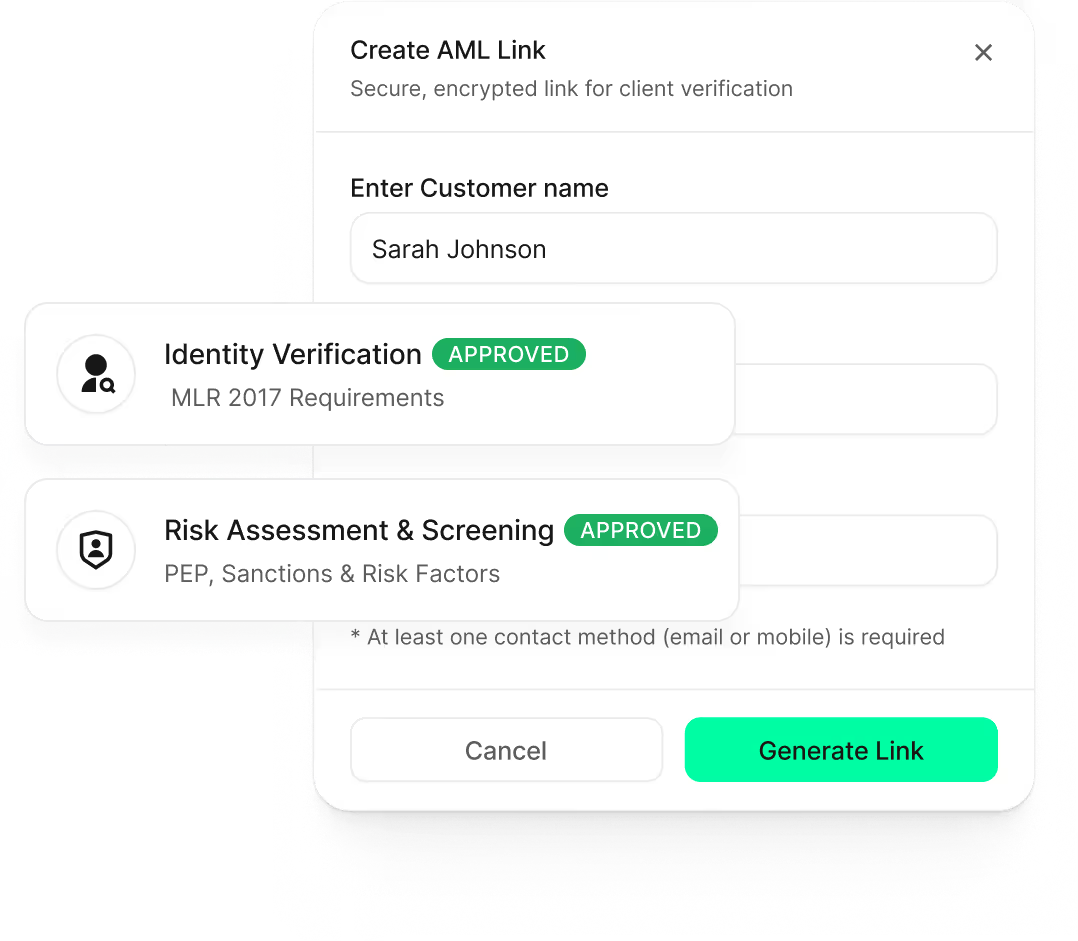
Send a secure link to the landlord, each tenant and any guarantor. They verify their identity on their phone. AML Buddy screens them and, when a PEP or address match is unclear, asks them clarifying questions before the result reaches you.
Under regulation 13(4) of the Money Laundering Regulations 2017, letting agency work is work you do on instructions from a prospective landlord or a prospective tenant, where the tenancy agreed is for a month or more and the rent, for at least part of the term, is or is equivalent to £10,000 a month or more.
The threshold used to be 10,000 euros. The Money Laundering and Terrorist Financing (Amendment) Regulations 2026 (SI 2026/621) changed it to £10,000 from 30 June 2026. HMRC’s guidance adds some practical points:
Some activities are not letting agency work on their own, such as only publishing adverts, only giving the parties a way to contact each other, or providing legal services. If you never handle lets at or above the threshold, you do not need to register with HMRC for this activity.
A letting agency business must apply to HMRC for anti-money laundering supervision before it carries out in-scope work; you can start once your application is made. HMRC’s fees from 1 December 2025 are £300 per application and £400 for each premises. Your beneficial owners, officers and managers must also pass HMRC’s approval checks.
AML supervision sits alongside, and does not replace, your other duties such as belonging to a redress scheme and protecting tenancy deposits.
Your customer is anyone you form a business relationship with on the let. In practice that means:
If you cannot complete the checks, you must not go ahead. End any existing relationship and consider whether to make a suspicious activity report to the National Crime Agency.
Apply enhanced due diligence when the risk is higher, for example for politically exposed persons or parties linked to a FATF call-for-action country. That includes verifying source of funds and source of wealth. Take extra care if a tenant wants to pay rent in cash, or if a non-UK resident uses intermediaries with no clear commercial reason.
In England, Right to Rent checks remain a separate duty. They do not count as customer due diligence.
You must keep monitoring the relationship for as long as it lasts, for example by re-screening landlords and tenants for new sanctions, PEP or adverse media matches. Keep copies of your customer due diligence and transaction records for five years after the business relationship ends (regulation 40).
You also need a written risk assessment, policies and controls, staff training and a nominated officer to receive internal suspicion reports. These are the documents HMRC asks for first at an HMRC inspection.
Corporate KYB checks for company landlords and tenants are coming soon. AML Buddy supports your checks; your firm remains responsible for its own risk assessment and decisions under the Money Laundering Regulations.
No. The Money Laundering Regulations only apply to letting agency work where the tenancy is for a month or more and the rent is, for at least part of the term, £10,000 a month or more (or the equivalent). If you never handle lets at that level, you do not need to register with HMRC for this activity.
It is £10,000. The Money Laundering and Terrorist Financing (Amendment) Regulations 2026 replaced the 10,000 euro figure with £10,000 from 30 June 2026.
Yes. HMRC expects you to identify and verify everyone who is a party to the letting, including guarantors and anyone acting on a party’s behalf, such as an agent, trustee or a company set up to hold the property.
No. HMRC’s guidance says no deposit can be taken to secure a property before customer due diligence is completed, and the tenancy cannot proceed until it is.
No. Right to Rent checks are a separate legal duty for letting agents in England. They do not replace customer due diligence under the Money Laundering Regulations.
Keep customer due diligence records for five years after the business relationship ends, for example when the tenancy you manage comes to an end. Transaction records follow the same five-year rule.